Building Independence for Adults with Autism

Most families raising an autistic adult are waiting for the big moment. The day everything clicks. The breakthrough that signals their loved one is finally ready to handle life on their own. But for adults with autism, independence rarely arrives as a single milestone. It grows quietly, in the morning routine that goes a little smoother, the meal prepped without a reminder, the appointment that gets out the door on time. Everyday home supports, when they are consistent and compassionate, are where real self-direction takes shape.
That is what Christian Servants Home Care was built to provide. Founded by a family of caregivers who entered this field out of genuine calling, not business opportunity, Christian Servants works with families across Missouri who are tired of a home-care industry that treats support as a transaction. What we offer instead is a caregiver who learns your loved one, shows up the same way every day, and understands that a trusted relationship is not a soft benefit. It is the mechanism through which real skill-building happens.

How Structured Home Routines Support Independence
Here is the counterintuitive truth most families don't expect: predictability is not the opposite of growth. For adults with autism, it is the precondition for it. When a routine handles "what comes next," the cognitive energy that would go toward figuring that out is freed up for something harder: actually practicing the skill. Structure, built well, does not limit a person. It gives them something solid enough to build from.
Routine Removes the Guesswork
When a morning routine follows the same order every day, an adult with autism does not have to decide what to do first, then second, then next. That decision fatigue is real, and it quietly drains the energy needed to follow through. A consistent structure channels focus toward doing the task rather than figuring it out, which means fewer meltdowns, less friction, and more days that actually go well.
Repetition Turns Practice Into Habit
Doing the same steps at the same time creates something powerful: a skill that sticks. When a person loads the dishwasher after dinner every night, they are not just completing a chore. They are making a decision in context, and over time that decision becomes automatic. That is the difference between knowing how to do something and actually doing it without being reminded.
Good Routines Leave Room for the Person
A routine that removes all choice is not independence training. It is just a schedule. The goal is a structure that guides without hovering, one that lets the individual set their own pace, make small decisions within the routine, and feel the satisfaction of finishing something on their own terms. That balance, between support and self-direction, is where real confidence takes root.
Daily Living Skills That Build Confidence at Home
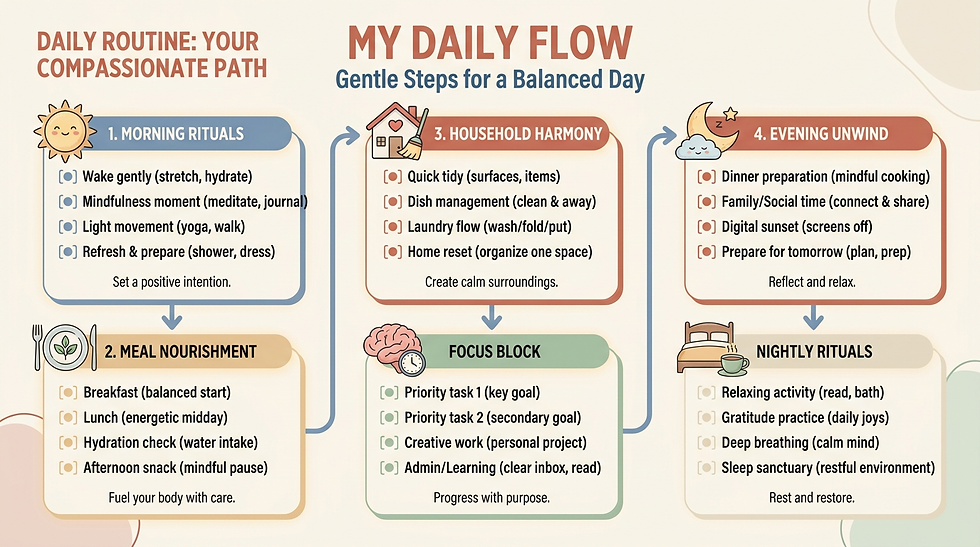
Personal care, meal preparation, household chores, schedule management, and community readiness are the daily living skills that most help adults with autism build confidence at home. Each produces a visible result — a clean kitchen, a packed bag, a medication logged on time — which is what makes them natural confidence-builders. Families can make that progress easier to see by breaking each skill into small, consistent actions and measuring success by follow-through, not by perfection.
| Skill Area | Example Home Tasks | Why It Builds Confidence | Support Level Needed |
| --- | --- | --- | --- |
| Personal Care | Showering, grooming, dressing in a set sequence | Completing a predictable routine reinforces self-awareness and personal agency | Verbal prompts or step-by-step visual cues |
| Meal Preparation | Following a simple recipe, assembling a snack, using the microwave safely | Produces a tangible result and encourages decision-making around food | Side-by-side coaching with gradual fade-out |
| Household Chores | Laundry, vacuuming, wiping counters, taking out trash | Creates a sense of contribution and ownership over one's living space | Demonstration, then independent practice with check-ins |
| Schedule Management | Using a daily checklist, setting phone reminders, tracking medication times | Reduces reliance on others for prompting and builds self-monitoring habits | Initial setup support, ongoing light reminders |
| Community Readiness | Preparing for appointments, organizing a bag, practicing transportation steps | Connects home skills to real-world situations and broadens confidence | Rehearsal at home before community outings |
Celebrating consistency over perfection keeps motivation alive and builds the kind of trust in oneself that carries over from one task to the next. When each skill is practiced in the same environment, at the same time, and with the same steady support, daily living stops feeling like a checklist and starts feeling like capability.
What In-Home Support Looks Like Day to Day
Effective in-home support helps adults with autism practice personal care and household tasks by coaching alongside them — doing it with them rather than for them — so the individual can participate, build the skill, and hold onto it over time.
Here is what that looks like in practice:
● Coach alongside, don't take over. A caregiver might walk through a morning hygiene routine step by step, offering a verbal prompt before stepping in physically, so the individual does as much as they can on their own each time.
● Notice patterns before problems grow. Consistent caregivers pick up on small shifts, a change in mood, a skipped meal, a routine suddenly resisted, and address them calmly before they become bigger setbacks.
● Give reminders without pressure. A calm, well-timed reminder to take medication or start a chore carries far more weight than correction after the fact. It keeps the individual moving forward with confidence rather than self-doubt.
● Help people recover from hard days without shame. Routines fall apart sometimes. A trusted caregiver helps the individual reset without treating a rough morning like a failure, which protects dignity and keeps motivation intact.
● Stay consistent in personality and approach. Adults with autism often communicate and process information differently from person to person. When support comes from someone familiar, respectful, and genuinely attentive, trust builds and skills transfer more readily.
That last point carries more weight than most families expect, and it is where the broken home-care industry most often fails. When a revolving door of unfamiliar faces provides support, adults with autism spend their energy re-establishing safety instead of building skill. A caregiver who shows up the same way every time, who has learned how a person thinks, what pace they need, which cues help and which do not, offers more than comfort. That familiarity is what makes engagement possible. At Christian Servants Home Care, we are a family of caregivers who chose this work because we believe care is a calling. That conviction is what drives the consistency our clients depend on.

Frequently Asked Questions About Autism and Home Support
Families supporting adults with autism at home often carry questions they rarely get to ask out loud. The answers below speak directly to the practical concerns that come up when daily living support is part of the picture.
How much help should an adult with autism receive at home without becoming too dependent?
The goal of good support is to do less over time, not more. A caregiver should guide and coach rather than take over. When help is matched to what someone actually needs in the moment, it builds skill and confidence instead of creating reliance.
What if routines work one week and fall apart the next?
Inconsistency is normal and does not mean progress has been lost. Stress, illness, or changes in schedule can disrupt even well-established habits. The most helpful response is to return to the routine calmly and consistently, without treating the setback as a failure.
When is it time to bring in a professional caregiver for daily living support?
If daily tasks are causing ongoing stress for the whole family, or if your loved one's progress has plateaued without consistent support, professional home care is worth considering. A caregiver who knows your family's rhythms can step in to reinforce routines in ways that feel natural and respectful. Learn more about what that support can look like at Christian Servants Home Care.
Can adults with autism improve independence even later in adulthood?
Yes. Skill-building does not have a cut-off age. Adults with autism can continue to grow in confidence and capability when support is consistent and the environment is predictable. That growth may look like learning to prepare a simple meal, follow a morning checklist without prompting, or manage part of a weekly routine with less hands-on help. Small gains made steadily over months add up to real, lasting change.
Build Independence One Routine at a Time
For adults with autism, the path to greater independence is not found in a program. It is found in a caregiver who shows up the same way every day, who learns how your loved one thinks and moves through their world, and who responds with patience rather than pressure. Daily tasks become genuine skills. Genuine skills become confidence. And confidence, accumulated through hundreds of ordinary mornings, becomes something no checklist can create: a life your loved one can direct on their own terms.
That is the work we feel called to do. Christian Servants Home Care's home care services for adults with autism span personal care and medication reminders, transportation, errands, and household support, with every service shaped around the individual, not around a standard package. If your family is ready to move from surviving the day to building toward something more, reach out and let us show you what client-centered care looks like when it is guided by genuine compassion.


Comments